The USA, the city, and a cleared record.
In this video? Ask for a change or have it taken down.
Keep up with new releases. Get the newsletter, once a week
Answers What would you say to someone under ten?, see how other cities answered
To quote this piece: Sha, “The USA, the city, and a cleared record,” We Them Media, https://wethem.xyz/watch/what-do-you-think-about-the-usa-germantown-philadelphia. Each transcript line links to its second.
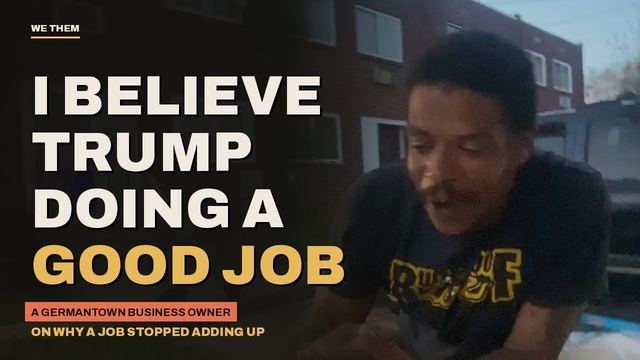
Five minutes on a Germantown block in Philadelphia, filmed for the question the channel was putting to people that week: what do you think about the USA. The interviewer sets it up first, that submissions have come in from Nigeria, Kenya, Uganda and India, and that he is trying to get people in the States asking questions too. The man who answers gives his name, his age, 35, and his neighbourhood, “from Germantown”.
Sha starts with who actually runs a government. “In other in other countries, they run the government, so there’s different standards and rules to what goes on out there”, he says, and sets this country against that: “Over here in the United States, there’s stipulations, guidelines and standards to the way they run our government.” What that does to the person underneath it he puts plainly. “Makes it to where like we got to bow down.” Hearing the phrase repeated back at him, he trims it: “Not bow down, but you know rules and standards, rules and regulations to it.”
The city comes next. “It’s just the borderline crisis”, he says, then reaches for the harder phrase: “War zone crisis.” Asked to say more, he stops. “No, I ain’t going to pretty much I ain’t I ain’t saying that.” He is asked twice and does not take it further.
Asked what has changed in Philadelphia since he was in high school, he names one thing, Meek Mill’s reform. He says he saw it on Twitter, and what he values in it is the paperwork: “we can get off. We can get our record cleared.” Told that is not a small thing, he agrees, “No, it’s big.” The detail he keeps coming back to is what an old charge does to a job application, that “when you go look for a job all this stuff not popped up on your record”, and that “even if you didn’t get found guilty, it’s still the job is still sitting on your record that you got.” The fix, in his words, is that “You clear it then it clears it.” His message to Meek Mill is short: “No, he did good. That was a good positive move for the city.” He puts him “more on the social and legal side of things”, and “Not really into the streets”.
The end of the tape is lighter. George Washington High School, and “That’s where Kevin Hart went.” Then his own question for the world: “What in life makes them happy? Going through all that we go through. You know life is hard.” He half answers it himself, that “Everybody got something that motivates them, makes them happy to still want to go on in life”, and then, quietly, “You got some people that take a different route out.” For anybody under seven he leaves three words, “school, read, write. Highly important.” That is the whole interview, done standing on his own street.