Neighbors organizing music and speakers in Germantown.
In this video? Ask for a change or have it taken down.
Keep up with new releases. Get the newsletter, once a week
To quote this piece: Mitsy, “Neighbors organizing music and speakers in Germantown,” We Them Media, https://wethem.xyz/watch/what-we-the-people-looks-like-germantown-philadelphia. Each transcript line links to its second.
Eight minutes in Philadelphia with an organizer explaining what a local group called We the People is, how it started, and why there are musicians at it. Mitsy, as the live title has her, does most of the talking.
The definition comes first: “a community of people who live in proximity and know each other, who, uh, have various areas of experience and expertise to organize.” The example she reaches for is a person, “Ann Mintz is one of the first people that comes to mind”, who ran “house concerts or organized music events at Redding Terminal Market” and “was at Ben Franklin Institute as an organizer”, so “she was an experienced person to how to plan something.”
The model came from elsewhere and went local fast. She points at Minneapolis, and at ICE, and says “we had our version here in Germantown, West Mount Airy, Chestnut Hill, Elkins Park”. Someone said “I can organize musicians”, a connector “in the web of musical connections here”, and the format followed from that: musicians play and “a serious speaker speaks to the issue” of immigration detention, schools, medical systems, everything “taking away the supports that we need.”
Then the argument. “So we have to, like, be voices, basically”, she says, and the power is small and near: “We have some power, but we understand it’s locally.” It started in April of last year, on Wednesdays, at a shady little station: “Allen’s Lane train station is where we first started.” The name is read back to the Constitution, “it’s our government’s supposed to work for us”.
She does not pretend it is cheerful. The point of an evening is to “listen to smart people and play some music and give ourselves a sense of hope”, because “it is frickin’ dispiriting, traumatizing” to live here now. Her account of how it got this way is mostly about feeds: “there are billionaires who have the capacity to absolutely train the algorithms that feed everybody’s social media feeds”, and two camps, the pro-social one and the one that is “outright graft, outright corruption, anti-science.”
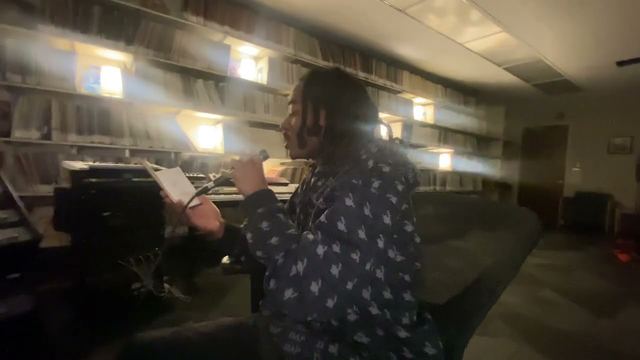
The last third is about outlets. She wants people to “show up and videotape”, and notes that “we have our own storytelling in Philadelphia”, a local answer to Moth Radio Hour where you draw a number and “you got 5 minutes and they give you a topic”. On her first visit “My number was pulled”, and “I’m glad it was recorded and it went on the internet.” She names G-Town Radio, tells Maceo she wants to see more of him, and ends on the reason she talks to anybody with a camera: hearing other people’s frames.