A pitch for credit that does not need a bank.
In this video? Ask for a change or have it taken down.
Keep up with new releases. Get the newsletter, once a week
Executive producer: C.Y. Lee
To quote this piece: “A pitch for credit that does not need a bank,” We Them Media, https://wethem.xyz/watch/staking-a-salary-to-cover-the-rent-ethiopia. Each transcript line links to its second.
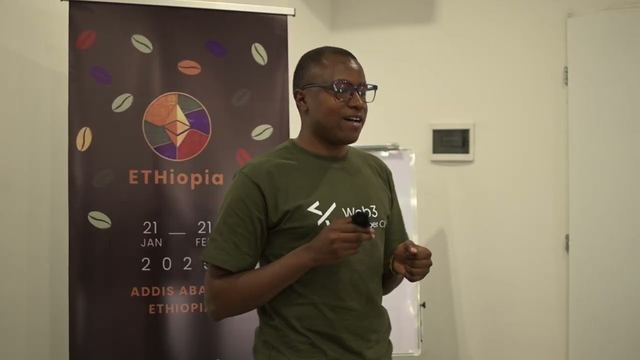
Four minutes of pitch footage from the ETHiopia pop-up city, one presenter at the front of a room of builders, making the case for credit that runs on crypto instead of a bank account. The title of the piece calls the project Hakiba.
The opening is a scenario rather than a thesis. Imagine “you earn in crypto or you are a freelancer who received payment in USDC” and rent is due, “But your salary hasn’t yet arrived.” The product sits in that gap: “stake your salary, maybe last month’s salary”, cover this month’s rent, and “you’ll be able to pay that money or that credit after your salary has come up.” The framing behind it is that “ever since the beginning of crypto it has been an asset for speculation and investment”, and this is an argument for using it as something else.
Then the market. Africa, the pitch says, “it has been the fastest growing crypto market globally”, and the figures that follow are garbled in the transcript. The problem underneath is not. “there is an issue with limited financial access”, he says: “if you have USDC that you are holding, you have to convert it to fiat for you to be able to get a credit.” Add the “overreliance of traditional credit, we rely on bank to give us credit”, and the consequence is plain, “if you don’t have a bank account you can’t get any credit.”
The build follows from that. “we are building Akiba which is introducing a seamless way for user to save, earn, borrow using their crypto all while maintaining full control of their asset.” In practice, “you come with your wallet, deposit crypto, stake it” and earn while it sits, so that you can “spend more when you have less”, the line the video takes its title from. On competitors he is candid, “We have done our research and we found out we are not alone”, and names a few lenders the transcript mangles. The difference he claims is focus: they are “not focusing on African problem”, while “we are focusing on African users” with credit that is decentralized.
The ask is specific. “What we are asking for is 100,000 U.S.” He wants engineers, “front-end engineers specifically”, plus help to “establish a liquidity pool and have a go-to-market strategy as well as regulatory guidance.” Three weeks of work follow: architecture, the existing interface, a lending and borrowing contract, an “AI agent for credit scoring from your wallet transactions to your statements”, an on-ramp and off-ramp, then integration and testing. Then a thank you, and the tape ends.