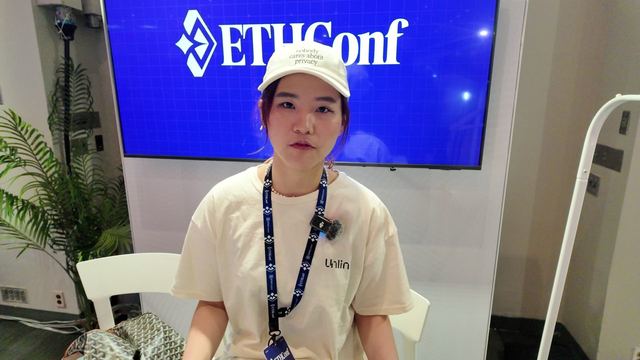
0:14BOkay, and what do you all do?
0:16ASo with Autoco, we’re putting companies on-chain. We feel like there’s a forgotten use case in tokenizing ownership in companies and smart contractifying them. And so it’s a use case that is used by a lot of people, but not known by a lot of people. You know, only the ones who care about how they set up their legal structure would typically go all the way and also incorporate their company on-chain. That’s kind of our use case.
0:48BOkay, awesome. And I’m curious, what do you feel like most people outside the crypto space, the blockchain space, aren’t understanding about the moment that we’re in with this technology?
0:56ALook, I think most people, they just hear about crypto and there’s the scams that are always reported in the main media, right? I think if they have heard about blockchain, they will just think about it at best that it’s the database, so to say, that clears a transaction, unlike Bitcoin and Ether. Have you heard of Ether? I think the most misunderstood or unknown part is smart contracts. And I think it’s the biggest power of blockchains. You know, for instance, if I put, let’s say that you and I own a company together, an LLC here in the United States. Okay. You got 50% of the membership. I got 50%. Okay. 50 tokens, 50 tokens of mine. It’s not about the tokens as such. It’s about the fact that we can program the tokens that if you would want to sell your 50%, you wouldn’t be able to because we programmed it such that you just can’t sell to somebody else. I don’t want to have like suddenly your uncle come in. I don’t know the guy. He may be a great guy. You see what I’m saying? And so it’s the ability to make equity and ownership programmable that is very misunderstood still, actually, after how many years now? 10, 12 years of smart contracts.
2:06BAnd what is ETH?
2:07AEthereum. Ethereum is the ledger and ETH is the currency of the ledger. I like to explain to people who don’t kind of like are deep into crypto that it’s like, think about it as like the oil in the real economy, think about ETH, Ether, as sort of the digital oil to power a whole digital economy. And when you explain it to people like that, they start thinking, oh my God, I see what’s happening here. That means the more we put stuff on-chain, the more ETH we’re gonna need. And I go like, yes, kind of exactly the way it works. It’s like a demand-supply thing. So if you really want to think about ETH as a digital oil, If you want to think about BTC as a digital gold, then think about ETH as a digital oil. And how do you --
2:51Bwhat do you have to say to people about like the volatility? Well, all the L2s, right? People say the L2s are going to reduce demand.
2:59AThe vol is obviously there. Vol is still going to be very much a hallmark of crypto until it becomes really mainstream. I think we’ve all been very wrong in thinking that crypto would happen so soon. And here we are. You know what? 2014 was mainnet launch. And so we are still here waiting for major use case, major adoption. But wait until that is more generally adopted. And I think it’s happening, you know, real-world assets going on-chain, companies being put on-chain that own the real-world assets. You’re going to see that volatility come down.
3:32BYeah.
3:32AMassive. It’s going to balance out more. Now on a late Friday night, well, kind of like, you know, I can still see that volatility spike up. Because the attention goes, I think there’s gonna be a moment where that market is getting 24/7, 365 attention all the time.
3:51BYeah.
3:52ABy major players. By major players.
3:54BYeah. People are underappreciating that right now.
3:57AIt’s definitely underappreciated. I think it’s underappreciated for 2 reasons. First is that it’s not clear that it is the oil that powers the digital economy and that economy is growing, you know, whatever the slump. Second, it’s gonna be the layer, the enabling technology for agentic AI to operate. You know, if we really gonna go to a place where agents, robots start transacting amongst themselves, so agent-to-agent commerce, they’re gonna need a layer. And that layer is most likely gonna be the Ethereum blockchain. You know, it’s secure, it’s the longest proven, it’s never been hacked. And so you’re gonna see a whole agentic economy being built on top of the Ethereum blockchain. And I think people don’t yet realize that. Okay.
4:37BAnd so for people like my great aunt, she’s 80, maybe 85, I think. And she uses Google Gemini and that’s pretty much it. That’s her whole AI exposure. What is like, what does agentic commerce even mean?
4:48AWell, it means that you’re gonna have basically automated transactions happening between agents that you spawn in real life and basically run businesses for you. So you wanna look at it almost as an extension of your own business building capacity, where previously I had one venture where I had to have full dedication because just holding a site up took me, you know, a couple of weeks maybe with a developer team. I can now just push that a lot quicker so I can probably entrepreneur in parallel because my agents are running stuff. My agent can receive payments, my agent can make payments, but for that they’re probably gonna need a blockchain to make those payments.
5:27BAnd I think it’s awesome. It’s just gonna empower people to do more with fewer, like, people involved. But I’m curious, do you feel like it’s gonna undermine people’s ability to work on teams?
5:35AIt’s not gonna undermine it. It’s gonna actually upgrade humanity. I think it’s gonna force us. I like to say that, you know, intelligence can’t be prompted. Understanding can’t be prompted. Intelligence, you can get an intelligent answer from an LLM now, from an OpenAI, from a Claude. But understanding, general understanding cannot be prompted. That’s always gonna be a human process where you explain something to me, I can question you, I can ask you some questions, I can probe you, I can critique you. I don’t think we are gonna get to that stage with AI, but obviously I can just look up the distance between the Earth and the moon on AI because it’s got that factual knowledge and it can explain that, but it can’t get you my understanding of how this will work. I think it’s gonna upgrade humanity. We are gonna do stuff that before we never thought we could do. Thanks to AI.
6:23BI saw that Claude, they announced this morning their new Fable 5 model. It’s like their most capable model yet. And they said that it still has concerns about like biology and cyberattacks and stuff like that. You know what I’m talking about?
6:36AWell, they’re obviously, you know, singing their own song sheet, but they’re, they’re a formidable piece of technology, no doubt. But essentially, if you listen to Yann LeCun, who was there very early on, I think he makes a fair point that it’s still an extrapolation of basically an LLM that draws in a lot of interference from other sources, neighboring sources, adjacent information. But does it get to the point where you get to consciousness, which is unique to humans? That is still the big question. That question has been there since what, 1971? Gödel-Escher Bach book, right?
7:11BWe keep going.
7:11AHofstadter. I mean, that question is still there. I like what Elon Musk thinks about AI, that it could effectively extend our consciousness in space. So humanity is more about extending consciousness, whether it’s in a physical body or a machine body. But I wonder if it’s ever going to get to a state of consciousness the way we have consciousness, where consciousness is basically The act of almost like thinking above where you are and start wondering about where do we come from, where do we go, sort of transcendent. I wonder if that’s --
7:42BThe meta conversation, like what happens between my eyeballs? I don’t really know.
7:45AYou got it. You got it. And I don’t, I don’t see AI going there. It will probably ruminate on it, speculate about it, but I’m not sure if it can actually transcend itself the way we can transcend ourselves. We’re going into very deep territory here for a A Tuesday afternoon, but yeah, I think that’s where I studied philosophy in undergrad. So, oh, you did? Okay, I got to accept it.
8:05BYeah, yeah, yeah. So I enjoy it, you know, I think it’s interesting. I’m curious, outside of crypto, outside tech, what stuff that really fascinates you?
8:12AI have a nonprofit educational school which is fully decentralized. Really? That is a project that is very close to my heart. That’s not venture, that’s not meant to make a profit, not to exit. And everybody will be able to teach. So the idea is that everybody -- actually, a lot of people want to teach but don’t get a chance to teach because you’re not part of university, you don’t have some sort of like pedigree in a college or whatever. And so we’re putting a school in place where anybody who feels like they want to transfer knowledge can transfer it by way of a lecture, a course. AI will help you structure the course and you will be able to teach. teach as long as you get funded by your students. So you put a course up there, people want to hear you teach, they’re going to fund you for your course. You set the course fee, you get funded in crypto, you can teach. Okay. Online and eventually also offline. What’s it called? It’s called Dedu, decentralized education. D-E-D-U. Look it up. Dedu School.
9:11BDedu School. Awesome. And do you have an X account?
9:14AYeah, I’ll send it on to you. You can follow it on That probably means time up. I’ll send up the -- you can put it in your X feed or whatever. The X account is didoo.school.
9:28BOkay, didoo.school. And do you have a personal one? So we’re going to tag you when we post the video.
9:31AYeah, it’s a long one. It’s my name. So that’s going to be difficult. Okay, no worries.
9:36BYou see that bio? You see that?
9:38AIt’s first name, last name combined. And that’s me on X. Okay, perfect.